Guides
How to produce GPS proof of leaflet distribution
Turn a walked route into evidence your client will accept — the GPS track, every individual drop, and the totals.
What the proof is for
On most jobs the walking is not the hard part — the conversation afterwards is. Was the leaflet really delivered on Bergstraße? Without evidence it is one person's word against another's, and the client who doubts it either pays late or pays less.
FlyerTrack records while the walk happens, with no extra taps for the carrier. What comes out the other end is a document containing the GPS track, every individual drop with its time and coordinates, and the totals per route. That is the proof.
Three steps to a client-ready report
-
1
Open the route
Routes lists every completed walk, newest first, with the carrier, campaign, drop count and distance. Anything not yet billed to a client is highlighted, so you can see at a glance what is still waiting for an invoice.
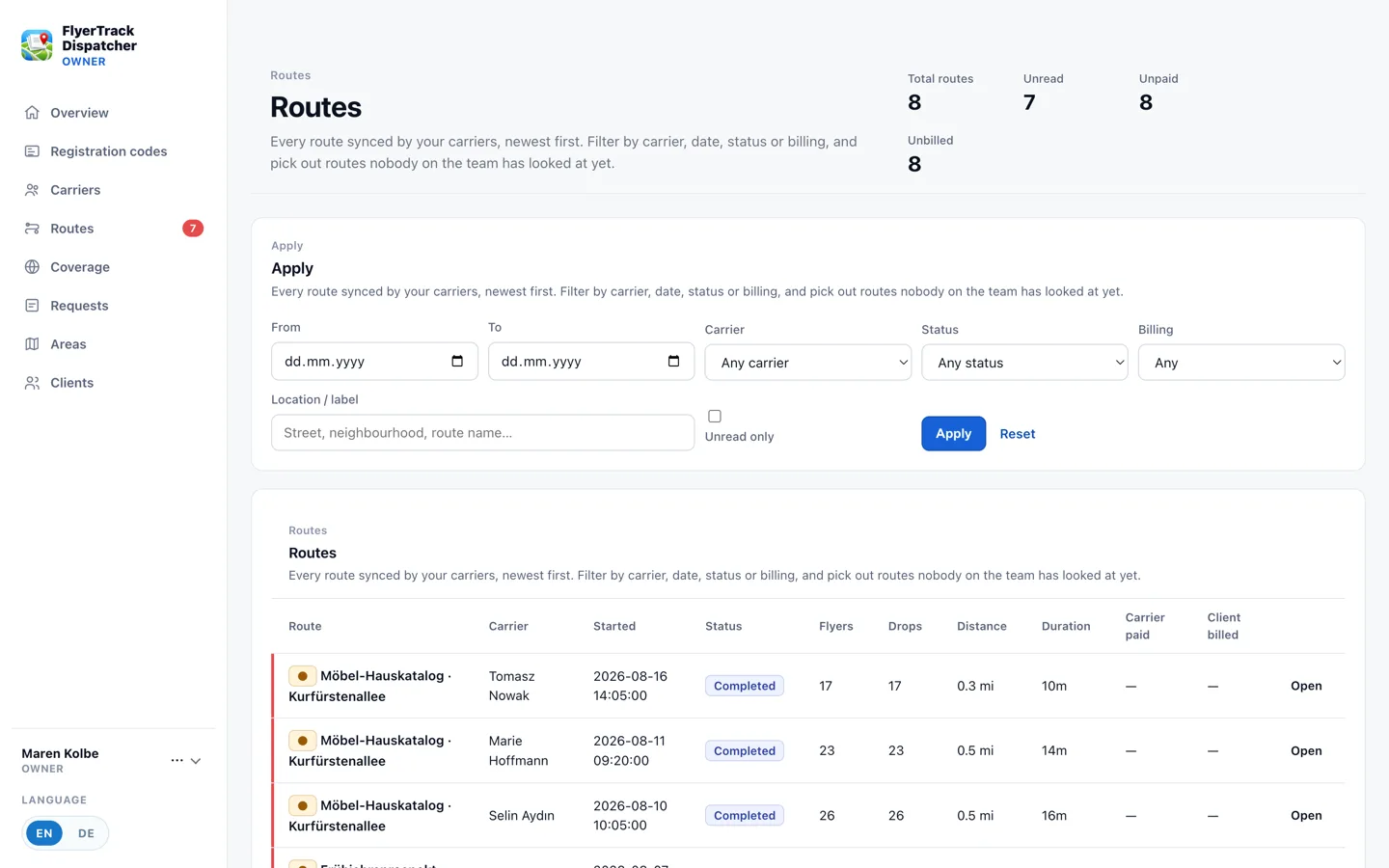
The route list. Unbilled walks are highlighted. -
2
Check it and assign the client
The detail view draws the walked track as a blue line and every drop as a pin. On the right you assign the route to the client it was walked for. This is the only manual step, and it decides what ends up in which export later.
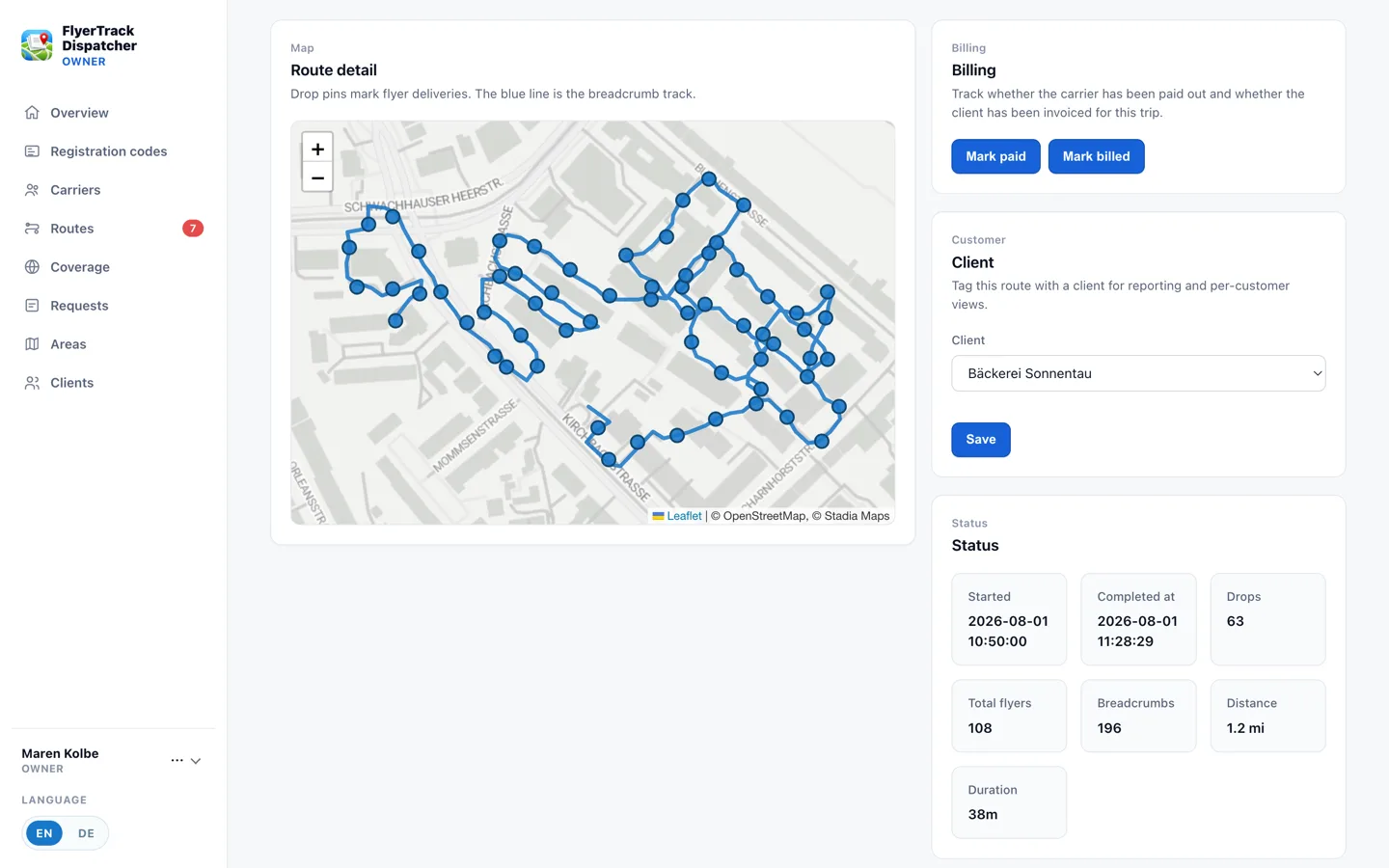
A single route: track, drops, duration, distance — and the client it belongs to. -
3
Export as PDF or spreadsheet
You can export per carrier or per client. The PDF is the document you hand over: a summary page, then the routes with date, campaign, drops, distance and duration. The spreadsheet (XLSX) is the same data in machine-readable form — for your own bookkeeping, or for a client who wants to work with the numbers.
What the proof shows — and what it doesn't
Say this to the client before it becomes an argument. The report shows that a device was in a particular place at a particular time and that a drop was logged there. It does not show that the leaflet went through one specific letterbox — no software can show that.
In built-up streets GPS is realistically accurate to a few metres, and worse between tall buildings. That is far more than enough to answer "was anyone on this street". It is not enough to answer "was it number 12 or number 14". Saying so plainly puts you in a stronger position than promising an accuracy that does not exist.
Try it on your own area
The free tier is enough to run the whole workflow with a single phone. No card required.
Create a free account